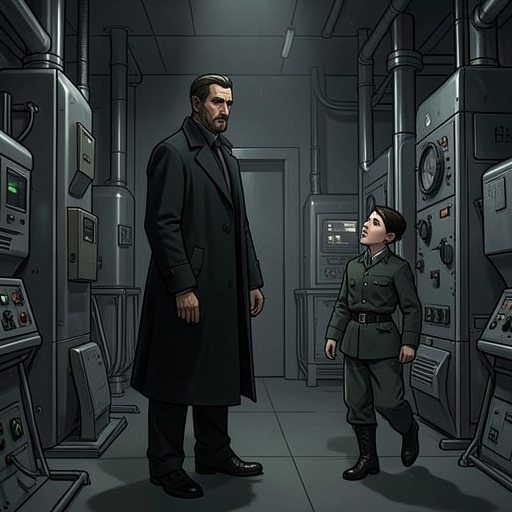
The alien disobeys the order to eliminate Isobel and Gulliver
The HumansThe alien narrator’s refusal to eliminate Isobel Martin and Gulliver Martin marks a decisive breach in the effort to suppress the consequences of Andrew Martin’s proof of the Riemann hypothesis. Faced with an explicit command to destroy both, he insists that there is no need to do so. He offers a less final means of containing what Gulliver knows: manipulating his memory. The exchange makes the distinction between completing a task and obeying its most violent interpretation impossible to ignore.
The Command and Its Stakes
The conversation follows the destruction of evidence on Andrew Martin’s and Daniel Russell’s computers and the report that Daniel Russell is dead. Against that backdrop, the question of whether Isobel and Gulliver have also been destroyed is not hypothetical: the order is to remove the remaining people who might connect the proof to its consequences. The alien narrator answers that neither has been harmed. He says Isobel knows nothing, while Gulliver knows what his father told him.
The order is then made explicit: both must be destroyed. Its repeated, categorical wording leaves no room to treat the demand as advice or as a request for further assessment. The alien narrator’s refusal is equally clear, but rests on a different judgment. In his view, killing Isobel and Gulliver is unnecessary. The conflict is therefore not a misunderstanding about the assignment; it is a dispute over whether its objective requires their deaths.
Refusal and the Alternative
Rather than simply denying that Gulliver knows anything, the alien narrator distinguishes between what Gulliver has heard and what he understands. He says Gulliver has no real understanding of mathematics, then proposes manipulating his neurological processes so that he forgets what his father told him. The alternative is specific: leave Gulliver alive, but remove the memory that might connect him to the proof.
That proposal does not amount to full compliance. The order is to destroy both people, whereas the alien narrator argues that neither needs to be destroyed and offers memory manipulation only as a possible measure against Gulliver. His response shows how he tries to preserve the mission’s practical purpose while rejecting the commanded means. It also makes the threatened intervention morally and materially distinct from killing: Gulliver would survive, but his access to an important part of his own experience would be taken from him.
The proposed solution is not presented as permanent. The surrounding exchange establishes that any mind manipulation would cease when the alien narrator returned home. That limitation makes his reassurance that Gulliver will remain silent less secure than it first sounds. Still, the alien narrator does not use the limitation as a reason to obey the order. He maintains that Gulliver has not spoken and that Isobel remains unaware, treating their present circumstances as sufficient grounds to spare them.
Gulliver as the Point of Disagreement
Gulliver becomes the central point of dispute because he is both a potential source of information and, in the alien narrator’s assessment, an unreliable interpreter of it. The authority pressing the order distrusts human beings and raises the possibility that Gulliver may already have said something. The alien narrator counters with his own account: Gulliver has said nothing, and lacks the mathematical understanding to make meaningful use of what he knows.
The disagreement is thus partly about evidence and partly about how human knowledge should be judged. The authority treats even the possibility of disclosure as a reason to eliminate the risk. The alien narrator weighs Gulliver’s actual silence and limited comprehension instead. His confidence does not erase the uncertainty in the exchange—the warning that Gulliver may already have spoken is left unresolved—but it does show him resisting the order’s assumption that possible risk justifies killing.
Isobel’s position is different. Both sides agree that she knows nothing, and the alien narrator uses that fact to argue against destroying her. The command nevertheless insists that she be eliminated along with Gulliver. By refusing to collapse their different circumstances into a single category of threat, the alien narrator challenges the order’s indiscriminate treatment of them.
The Threat of Replacement
The authority does not accept the alien narrator’s reasoning. It warns that if he fails to complete the task, someone else will be sent to do it. The warning transforms the disagreement into a test of whether his refusal can hold under pressure: the order is backed not only by authority but by the prospect of a replacement who may carry it out without hesitation.
The alien narrator answers that he will complete the task and tells the authority not to worry. Set beside his refusal to destroy Isobel and Gulliver, this assurance is deliberately unresolved. He promises completion without conceding that the commanded killings are necessary. The exchange does not disclose how he will ultimately reconcile those positions; it establishes the danger created by the gap between what he says he will do and what he has already refused to do.
As a turning point, the scene gives the mission’s internal conflict a human scale. The proof and its records have been targeted, Daniel Russell has died, and the command now extends to two members of the Martin family. Yet the alien narrator draws a boundary at their lives, even while considering an invasive alternative for Gulliver. The threat of replacement makes that boundary precarious: refusal has become not merely a private judgment but a direct challenge to the authority governing the mission.